Last updated:
Your gas furnace still lights, but it is getting old, and the air conditioner beside it isn’t young either. You are wondering whether one heat pump could do both jobs, and what it takes to get there in a Kenner house.
Sweet Olive installs ducted air-source heat pumps and converts gas-heated homes across Kenner and the rest of our service area. Kenner runs its own permit office, separate from the parish, and a conversion can touch the mechanical, electrical and gas sides at once. So on the first visit we look at the furnace, the flue, the ducts, the panel and the outdoor spot together. Your written estimate names the equipment, the duct work, the wiring, any gas capping and every city filing, priced line by line.
If you have no central system yet, start with new installation. If the furnace stays and only the cooling side failed, the conversion page explains both routes, and an inspection helps when you aren’t sure what is worth keeping.
Inside a Rivertown gas-to-heat-pump conversion
An attic gas furnace near the end, a raised cottage near the river and three Kenner filings: how one house moves its heating onto the system that already cools it.
- Location
- Rivertown, Kenner
- Home
- Raised single-story frame cottage, about 1,350 sq ft, two bedrooms
- System
- Nominal 2.5-ton two-stage heat pump with a 5 kW heat strip
- Removed
- Attic gas furnace, flue pipe and roof cap
- Gas
- Furnace branch capped; water heater stays on gas
- Outdoor unit
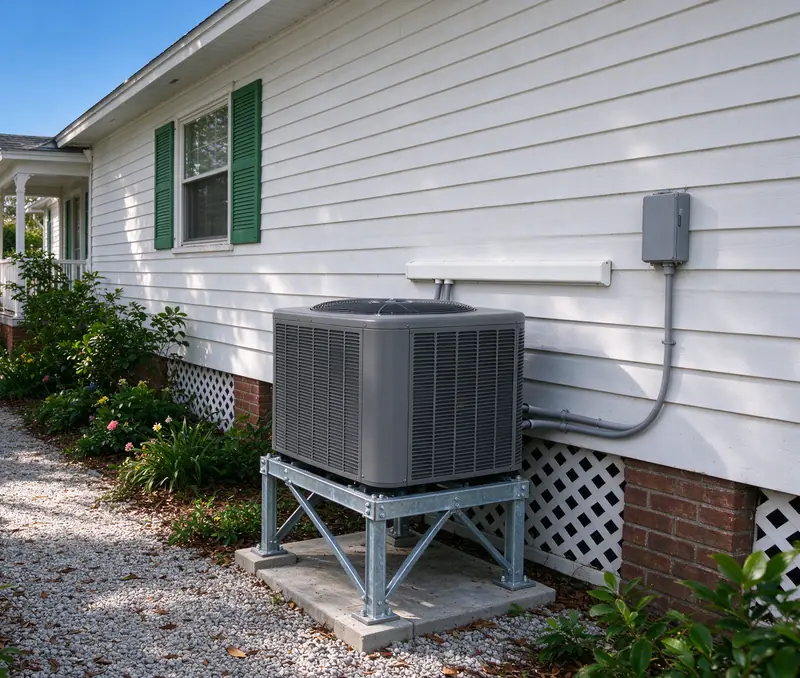
- 18-inch stand, 30-foot line set
- Project price
- $9,550
- Duration
- 3 working days
The house
A gas furnace in the attic of a raised cottage
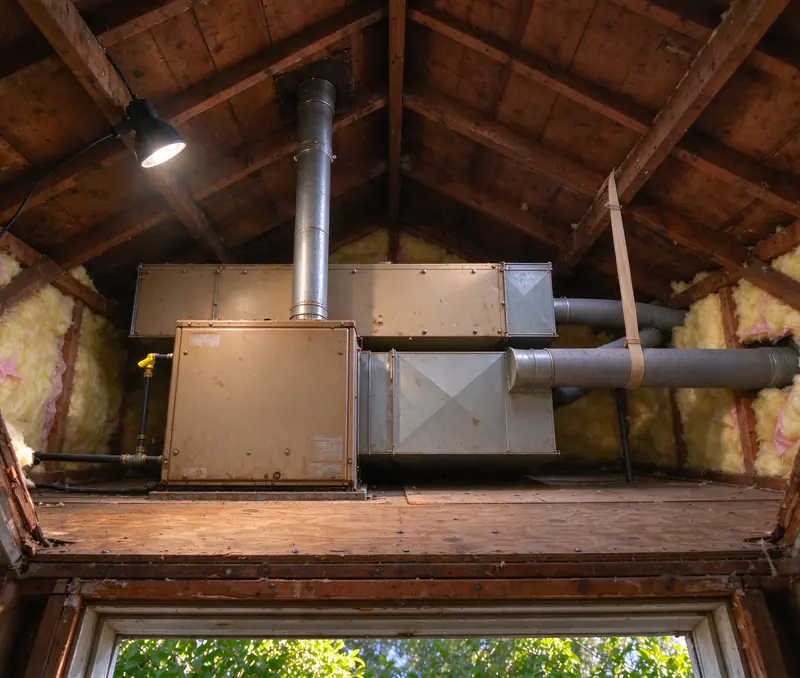
The cottage sits a few feet off the ground in Rivertown, about 1,350 square feet with two bedrooms. Heat comes from a gas furnace lying in the attic with an air conditioning coil on its outlet, and the furnace is worn out. The owner wants heating and cooling from one electric system. The water heater also runs on gas, so the gas service stays.
The decision
A heat pump, not a new furnace
We priced a dual-fuel setup that keeps a new furnace as backup, and a straight conversion. The room-by-room load calculation supports a nominal two-and-a-half-ton, two-stage heat pump, and a 5 kW heat strip covers the coldest mornings, so the owner chooses the conversion. The existing attic ducts pass the leakage test; the back bedroom gets a jumper duct to the hall return.
- Dark circle, Air handler: on an attic platform, over a secondary drain pan
- Ochre square, Supply runs: dropping to ceiling registers
- Blue diamond, Central return: in the hall ceiling
- Yellow triangle, Jumper duct: from a closed bedroom to the hall
- Open ring, Line set and drain: along the outside wall
- Dark cross, Outdoor unit: on a raised stand, with its disconnect
The work
Three filings and three working days
Kenner takes the mechanical filing, and the gas and electrical work go on their own forms, so each trade files before day one. Day one recovers the refrigerant, a gas fitter caps the furnace branch at the tee, and we lower the furnace through the hall opening. Day two sets the air handler on a new platform over a secondary pan with a float switch, pulls the flue pipe and seals the roof where it passed through. An electrician adds the heat-strip circuit while we set the outdoor unit on an 18-inch stand.
The handover
Backup heat checked before the city inspection
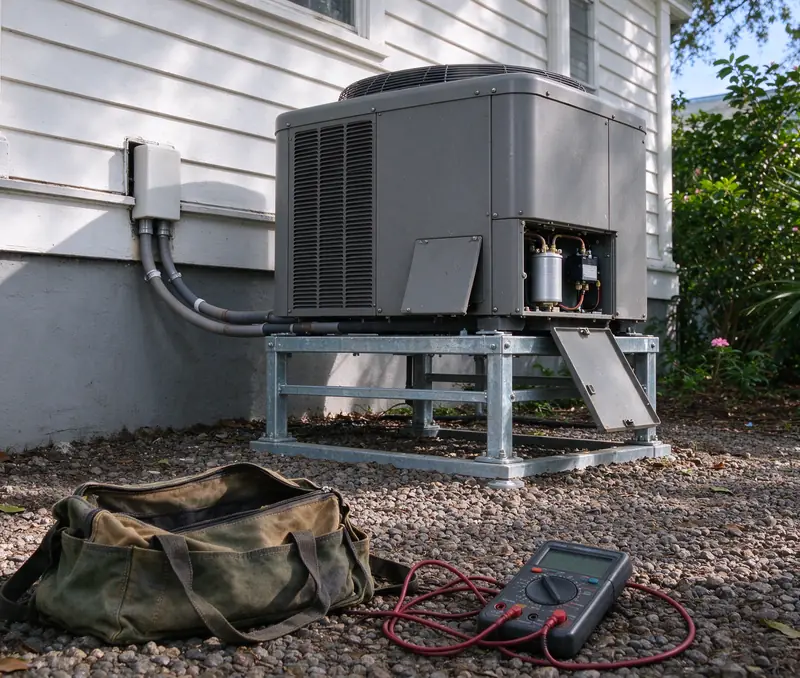
Day three runs the 30-foot line set brazed under nitrogen, the pressure test and the evacuation, then the charge, airflow and static pressure. We confirm the heat strip and the defrost cycle, set the thermostat's stages, and leave the readings with the owner. The aim is one system for summer and winter, with no open flame left in the attic.
Kenner files its own permits
The city, not Jefferson Parish, handles the paperwork for a Kenner address.
One city office, several forms
Kenner is an incorporated city, and its Inspection and Code Enforcement Department processes permit applications and coordinates inspections. The city keeps separate filing forms for electrical, gas, mechanical and plumbing work. A straight replacement is usually a mechanical filing. A gas-to-heat-pump conversion can add an electrical filing for a new circuit and a gas filing for capping the furnace branch. Your estimate lists each one and states who obtains it, and our permit guide compares the offices around New Orleans.
The codes the city works from
Kenner lists the 2021 International Mechanical Code and the 2021 International Energy Conservation Code among the codes it follows, each with Louisiana’s state amendments. Those set the ground rules for the equipment, the duct sealing and the controls, and the city inspection checks the finished work against them.
| Part of the job | Filing | When it applies |
|---|---|---|
| Equipment, line set and ducts | Mechanical | Every installation, replacement or conversion |
| New circuit or panel work | Electrical | When the heat pump or heat strip needs a new circuit |
| Capping a furnace gas branch | Gas | Gas-to-heat-pump conversions |
| Address east of Kenner | Jefferson Parish | Metairie and River Ridge addresses |
The filings a Kenner heat pump job can involve; your estimate shows which apply to your house.
From the lake to the river: what changes the job
Kenner stretches from Lake Pontchartrain down to the Mississippi, and the houses change along the way.
7.62 in
Average June rainfall at the New Orleans airport in Kenner, from National Weather Service climate normals
Heavy summer rain and the humidity that follows it are why we treat moisture removal as part of the sizing, not an extra.
North of Airline
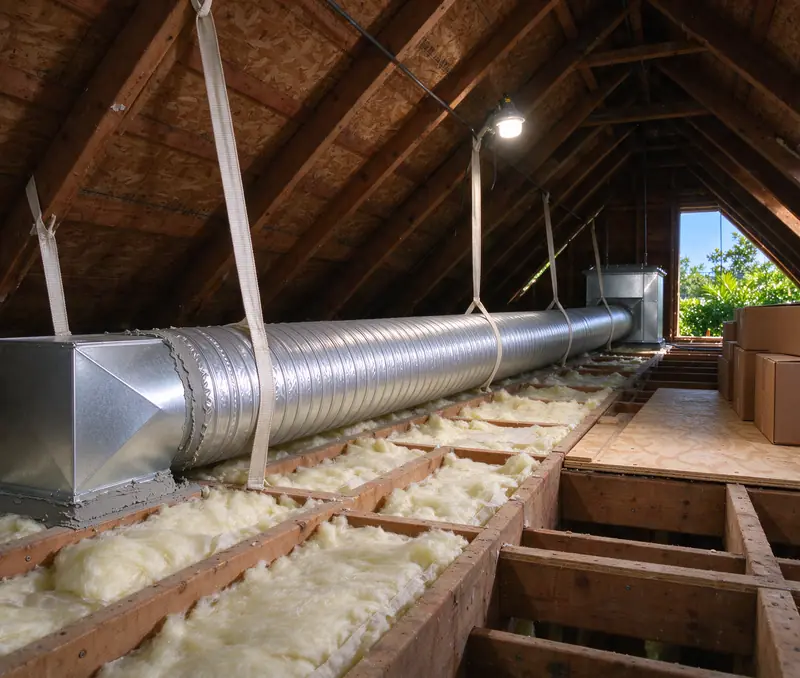
Much of north Kenner was drained, filled and built out from the late 1950s onward. Where a house there sits on a slab, the air handler goes in a closet or up in the attic, and the ducts run overhead. Attic headroom, the size of the access opening and the return path from each bedroom decide most of the plan. Our ductwork guide shows what we test before reusing ducts.
Rivertown and the older streets
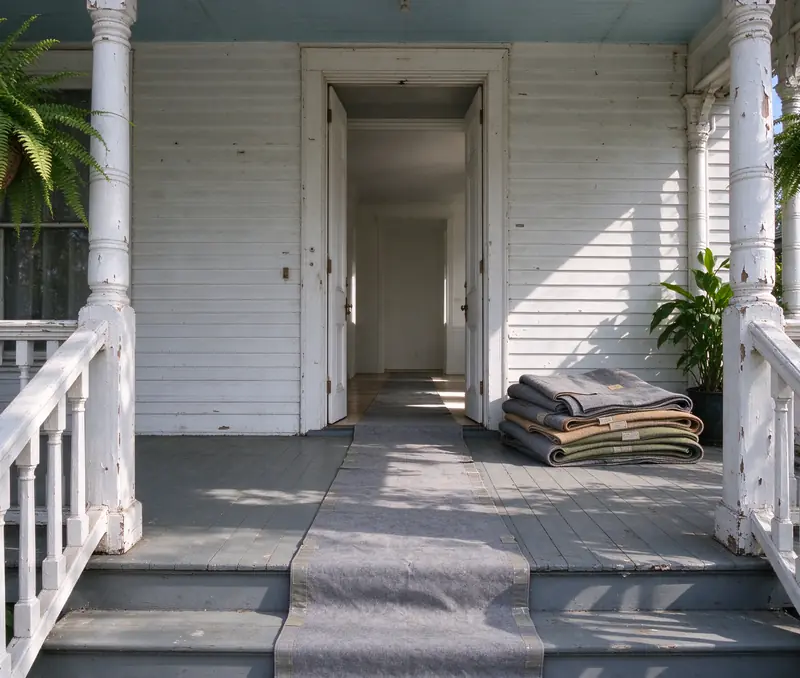
Near the river, around Rivertown and Williams Boulevard, the streets are older and some houses stand on piers. There we keep the air handler and ducts out of the space under the floor and plan an attic layout instead, with a secondary drain pan and float switch under any cabinet above a ceiling.
Where the outdoor unit sits
Wherever the house is, manufacturers set clearances around the coil and the service panel, and a low spot in the yard calls for a stand. We check the yard after rain, not just on a dry day, and the placement guide shows the options.
Gas furnace, dual fuel or a full heat pump?
Three ways to handle a Kenner house that heats with gas today.
Full conversion
A heat pump heats and cools; a small electric heat strip covers cold snaps and defrost.
- One system to maintain
- Furnace branch capped, flue removed
- Panel must carry the heat strip
Dual fuel
A heat pump handles most of the year; a gas furnace takes over in the cold.
- Keeps a sound furnace working
- Gas service and flue stay
- Controls must manage both
If the furnace is worn out, a full conversion usually makes more sense; if it is sound, dual fuel can keep it working.
Sizing comes before the decision
Either way, we run a room-by-room load calculation (ACCA Manual J) and size the heat pump from it, not from the old furnace or air conditioner nameplate. The heat strip is sized from the heating load, and the thermostat is set so the strip only runs when the heat pump needs help. The gas furnace comparison and dual-fuel guide go further.
The panel decides some of it
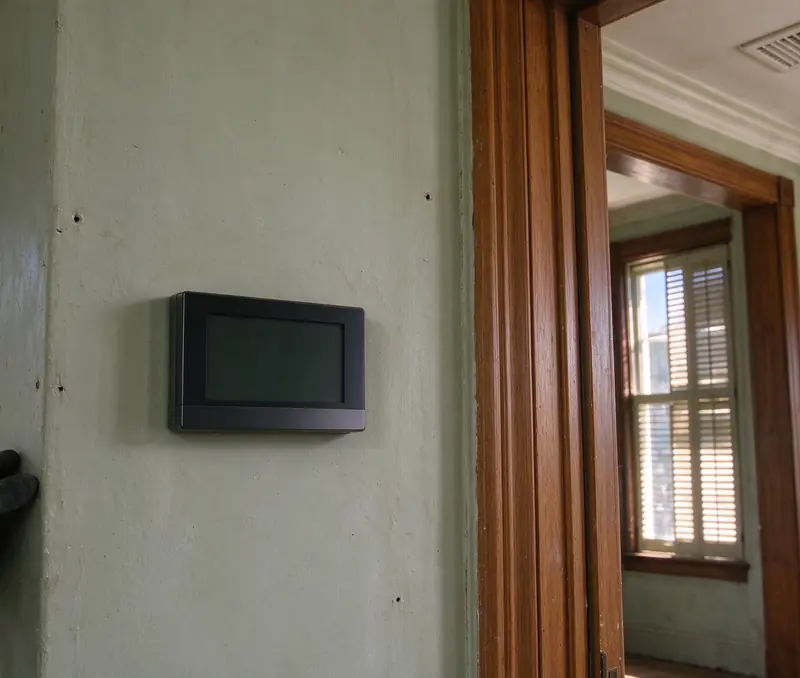
A conversion adds electric load where gas used to carry the heating. We check the panel’s rating, open spaces and existing circuits on the first visit. An electrician adds any new circuit, and a panel upgrade, if one is needed, is its own line; the electrical readiness guide explains the checks.
What a Kenner heat pump costs
Kenner's own permit office doesn't change our range; the house and the scope do.
Sweet Olive's typical range for a residential ducted heat pump installation is $4,250 to $11,750. We set your price after the site visit and write it into your estimate line by line, with each Kenner filing for your address shown separately.
What moves a Kenner price
- Equipment. Capacity from the load calculation, single-stage or two-stage, and the heat strip size.
- What comes out. A gas furnace, its flue and roof cap, or an old air conditioner only.
- The ducts. Resealing a few joints, adding a jumper duct, or replacing runs that fail the test.
- Electrical work. Reusing a sound circuit, adding one, or a panel upgrade as a separate line.
- Access and the outdoor spot. Attic headroom, closet size, line-set length and a stand on a low lot.
The federal 25C credit no longer applies to equipment placed in service after December 31, 2025, according to IRS guidance. The cost guide breaks a price into its parts, and the cost estimator gives a starting budget.