Last updated:
The registers blow warm air on a July afternoon. Or the house won’t warm up on a cold morning while the outdoor unit sits under a crust of ice. Or the system starts, stops and starts again every few minutes. Each of those can come from more than one fault, which is why the first thing a repair needs is a diagnosis, not a guess.
Sweet Olive repairs ducted heat pumps in homes across New Orleans. On a repair visit we test before we replace anything: electrical readings at the outdoor unit and the air handler, the drain, the controls and, where the symptoms point there, the refrigerant side. We explain what failed and price the repair before we start it.
If the fault turns out to be a compressor or a coil on a worn system, we price a replacement beside the repair so you can compare. If nothing is wrong yet and you want to know where the system stands, a heat pump inspection is the better visit.
A typical Mid-City heat pump repair
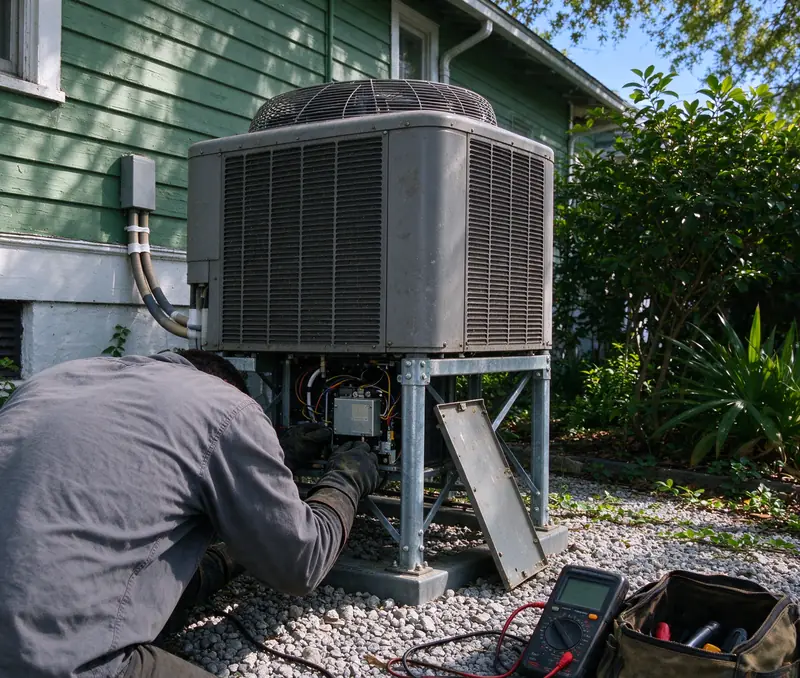
An August afternoon, warm air from the registers and an outdoor fan that won't turn: what a repair visit finds before any part is changed.
- Location
- Mid-City, New Orleans
- Home
- Raised single-story home, about 1,500 sq ft, three bedrooms
- System
- Nominal 3-ton single-stage heat pump, closet air handler
- Symptom
- Warm air from the vents; outdoor fan not turning
- Parts
- 45/5 µF dual-run capacitor, 30-amp two-pole contactor
- Also found
- Condensate line partly blocked; cleared and flushed
- Project price
- $385
- Duration
- One visit, about 3 hours
The call
Warm air on an August afternoon
The home is a raised, single-story house in Mid-City, about 1,500 square feet, with a three-ton heat pump and an air handler in a hall closet. On a hot afternoon the registers blow warm air. Outside, the unit hums, the fan blade sits still and the compressor clicks off after a few minutes.
The diagnosis
Test before replacing anything
We shut off power, discharge and test the dual-run capacitor and find it reading well below its 45 and 5 microfarad rating. The contactor points are pitted and burned. The fan motor turns freely and its windings test sound, and the compressor's windings read normal, so the fault sits in the start and switching parts, not in a major component.
- Dark circle, Fan motor: windings test sound; kept
- Ochre square, Compressor: windings read normal; kept
- Blue diamond, Power from the disconnect: lands on the contactor's line side
- Yellow triangle, Contactor, 30 A two-pole: pitted points; replaced
- Yellow hexagon, Dual-run capacitor, 45/5 µF: tested weak; replaced. HERM runs to the compressor's start terminal, FAN to the fan motor, C to the run side of the contactor
- Shaded yellow: replaced on this visit
The repair
Two parts, then a full run
We replace the capacitor with a matching 45/5 microfarad part and the contactor with a 30-amp two-pole one, then restart the system and measure amp draw on the compressor and fan against the nameplate. While it runs, we find water sitting high in the condensate trap, so we clear the line, flush it and confirm the float switch shuts the system off when it should.
The close
Readings on the record
After a full cooling run we write the capacitor value, the amp draws and the temperature drop across the coil on the visit record and leave a copy with you. The price covers the diagnostic visit and both parts. The aim is a system that cools again, with readings a later visit can compare against.
What is your heat pump doing?
A symptom points to a few possible causes, never to one. This is what each one can mean, and what you can safely check before we arrive.
| Symptom | What it can mean | What you can check first |
|---|---|---|
| Warm air in cooling | A failed capacitor or contactor, a stopped outdoor fan, low refrigerant, a dirty coil | The thermostat is set to cool, and the outdoor unit is running |
| No heat, or heat that never catches up | A reversing valve or defrost fault, low charge, a heat strip that won’t come on | The thermostat is set to heat, and the outdoor coil isn’t solid ice |
| Short cycling | Oversized equipment, a thermostat in the wrong spot, a tripped safety switch, low airflow | A clean filter and open registers |
| Water on the floor or ceiling | A blocked condensate drain, a rusted pan, a missing float switch | Turn the system off to stop the water |
| Loud buzzing, grinding or rattling | A failing motor or capacitor, loose panels, debris in the fan | Nothing; switch it off if the noise is new and harsh |
| Breaker trips | A shorted motor, a failing compressor, a loose or burned connection | Reset once; if it trips again, leave it off |
Common heat pump symptoms, their possible causes and the safe checks to make first.
The checks to leave alone
Please don’t open the panels, jump a switch or add refrigerant from a store kit. Those steps can hide the real fault, damage the compressor or leave live wiring exposed. Our warning signs guide covers what to watch for between visits.
What happens on a repair visit
We start with the simple causes, then move to the parts that need meters and gauges.
Outside: power, switching and the fan
With the power off, we check the disconnect, the contactor and the capacitor, then restart the unit and measure amp draw on the compressor and the fan motor against the nameplate. A capacitor that reads below its rating, burned contactor points or a motor drawing too much current each tell a different story.
Inside: airflow, drain and backup heat
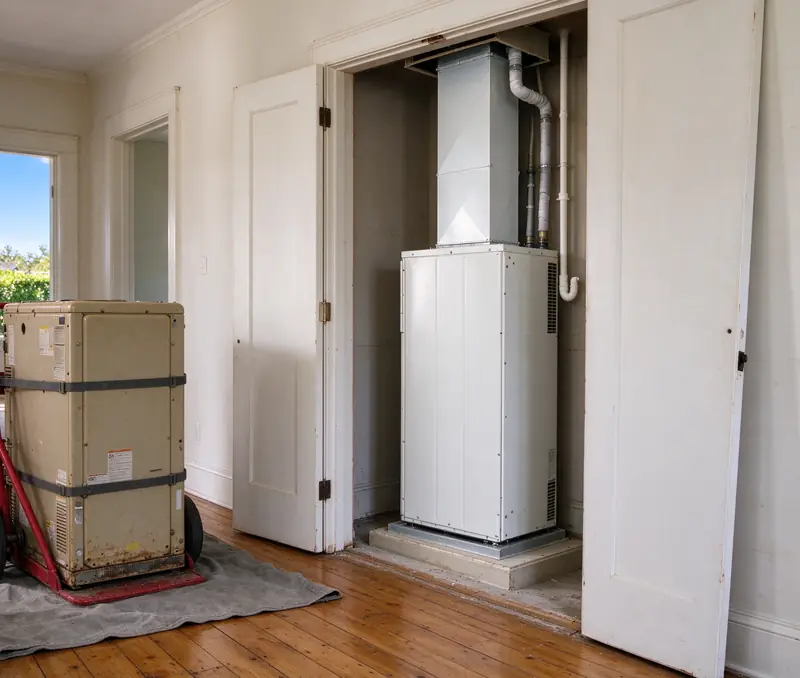
At the air handler we look at the filter, the blower, the coil and the drain, then test the float switch and, in heat mode, the heat strip. Low airflow from a clogged filter or a dirty coil can freeze the coil in summer and overheat the system in winter, so we rule it out before blaming the refrigerant.
The refrigerant side, when the symptoms point there
If the electrical side checks out, we connect gauges and read pressures and line temperatures to see whether the charge, the metering device or the compressor is at fault. Low charge always means a leak somewhere; topping it up without finding the leak only delays the next call. A leak repair is brazed under nitrogen, pressure-tested and evacuated to a micron reading before the charge goes back in.
Before we fix anything
We explain what we found, what it rules out and what we still can’t tell. Then we price the repair. Nothing is replaced until you approve it.
Heat mode problems that aren't always faults
A heat pump heats differently from a gas furnace, and a few of its normal habits look like trouble.
54.3°F
Average daily temperature in January at the New Orleans airport, from National Weather Service climate normals
Most winter days here are mild for a heat pump. The cold snaps are when the heat strip and the defrost cycle earn their keep.
Air that feels cooler than a furnace
A heat pump delivers a steady stream of warm air rather than short blasts of hot air, so a hand on the register can feel cool even while the room warms. That is normal. A house that keeps losing ground on a cold morning is not.
Frost, steam and the defrost cycle
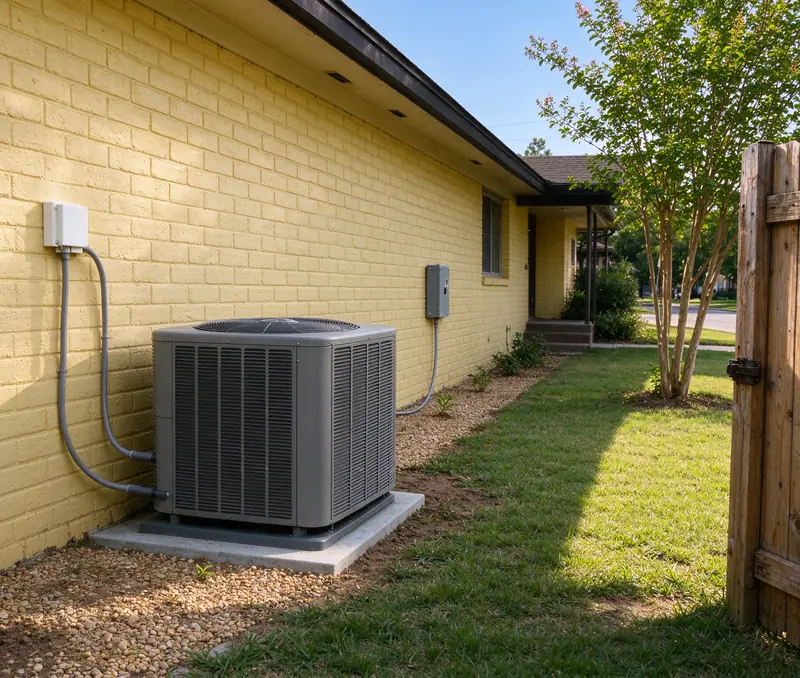
On cold, damp mornings frost forms on the outdoor coil. The system reverses for a few minutes to melt it, which can send steam off the unit and cool air from the vents. If the coil stays iced over, the defrost control, a sensor or the charge needs checking. Our cold weather guide explains how the backup heat fits in.
When a repair stops being the best answer
Most repairs are small. A few are the moment to look at the whole system.
Major components on a worn system
A failed compressor, outdoor coil, indoor coil or reversing valve is priced on its own, and on older equipment the bill can approach a large share of a new system. That is when we give you both prices: the repair, and a replacement sized from your rooms. The repair or replace guide walks through the comparison, and the components guide explains what each part does.
Repeat faults that point somewhere else
A capacitor that fails every summer, a coil that freezes again after a recharge, or a drain that overflows twice a season usually has a cause outside the part itself: restricted ducts, an oversized system, a poor drain slope or high static pressure. If we see a pattern, we tell you, and a ductwork repair or regular maintenance may fix more than another part would.
What a repair costs
The diagnosis sets the price, so you see it before any work starts.
Sweet Olive's typical range for a residential heat pump repair is $161 to $661. The diagnostic visit is its own line, and a major component such as a compressor or an indoor coil is priced separately once the failure is confirmed. We price the repair before we start and write it on your estimate.
What moves a repair price
- The part. A capacitor or contactor costs far less than a fan motor or a defrost control.
- Refrigerant work. Finding and brazing a leak, the pressure test, the evacuation and the charge add time and material.
- Access. An air handler in a tight attic or behind a finished closet takes longer to reach.
- The permit, where it applies. The City of New Orleans mechanical permit covers repairing heating and cooling equipment as well as installing it; your estimate says when a repair needs one. Our permit guide covers each office.