Last updated:
The heat pump stopped again, the repair quote is on the counter, and the hall ceiling still carries a faint stain from the last time the attic drain backed up. You want to know whether to fix it once more or replace it, and how to keep the ceiling dry either way.
Sweet Olive repairs, replaces and installs ducted air-source heat pumps in River Ridge and across our service area. In River Ridge the permit for a replacement goes to Jefferson Parish. Where the air handler sits in the attic, we plan the drain and its safety switch as carefully as the equipment. On the visit we look at what failed, what else is worn and how the attic unit drains. Your written estimate prices the repair, the replacement or both, with the parish permit steps included.
Read the repair or replace guide for the decision in full. The repair page covers fixes, and the replacement page covers the new system.
Inside a River Ridge attic replacement
A failing system above the hall ceiling, a water stain from an old overflow and no backup pan: how one River Ridge replacement is planned around the drain.
- Location
- River Ridge, near Jefferson Highway
- Home
- Single-story slab house, about 1,600 sq ft, three bedrooms
- System
- Nominal 3-ton single-stage matched system
- Air handler
- Attic, above the hall ceiling
- Drain
- Secondary pan, float switch, new PVC line with a cleanout
- Ductwork
- Existing ducts kept; three joints resealed
- Project price
- $7,950
- Duration
- 2 working days
The problem
A stain on the hall ceiling
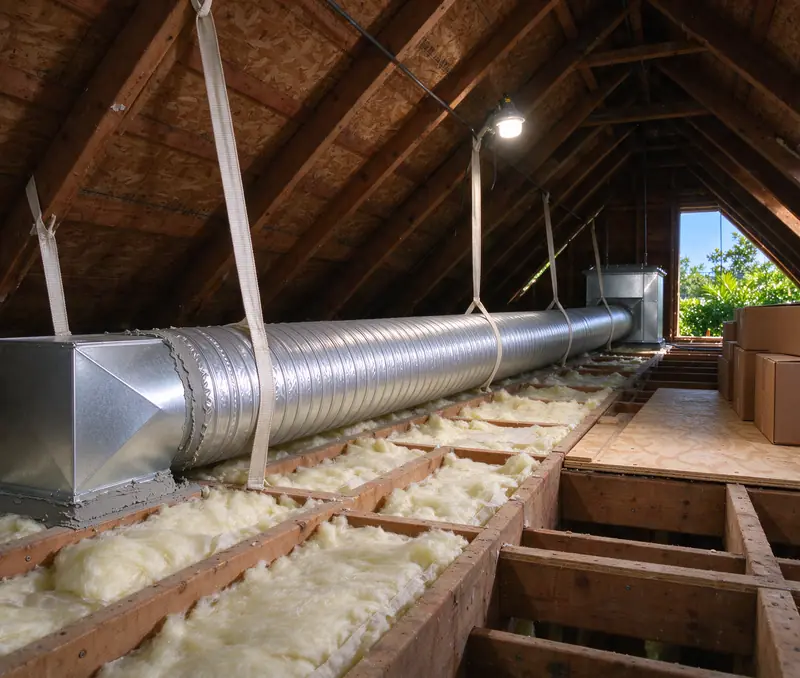
The house is a single-story slab home near Jefferson Highway in River Ridge, about 1,600 square feet with three bedrooms. Its heat pump is failing, and the hall ceiling carries a brown stain from the day the drain line clogged and the air handler overflowed. That air handler lies in the attic directly above the hall, with nothing under it but the ceiling.
The decision
Fix the drain before the ceiling pays for it
Moving the air handler into a closet would take a bedroom closet the owner wants to keep. We keep it in the attic and rebuild what sits around it: a platform with a secondary drain pan, a float switch that shuts the system off if the pan fills, and a new PVC drain with a cleanout. The ducts test sound apart from three leaking joints, and the load calculation supports a nominal three-ton system.
- Yellow triangle, Float switch: clipped to the pan rim; stops the system if the pan fills
- Dark circle, Air handler: on a new platform across the ceiling joists, over the hall
- Blue bar, Existing ducts kept: three joints resealed
- Ochre square, Trap and cleanout: at the air handler, cleanout capped
- Open ring, New PVC primary drain: sloped across the attic and out through the eave
- Yellow hexagon, Old overflow stain: on the hall ceiling, under the air handler
- Blue diamond, Secondary drain pan: under the whole air handler
- Dark cross, Attic stair: pulled down into the hall
The work
Two days, attic first
Day one protects the hall floor under the attic stair, recovers the refrigerant, lowers the old air handler and builds the new platform and pan. The new air handler goes on, the three joints are sealed with mastic and the drain is run with its trap and cleanout. Day two sets the outdoor unit, runs the line set, brazes under nitrogen, pressure-tests and evacuates.
The handover
Water in the pan, on purpose
Before startup readings, we pour water into the secondary pan to prove the float switch stops the system, then check the charge, airflow and static pressure. The readings stay with the owner and the parish inspection follows. The ceiling stain is left for the painter; the aim is that it never gets a second one.
One more repair, or a replacement?
The answer depends on what failed and what is wearing out behind it.
| What we find | Leans toward | Why |
|---|---|---|
| A failed capacitor, contactor or fan motor on a sound system | Repair | A small part on equipment with years left |
| A refrigerant leak at a reachable joint | Repair, then watch | Fixed and tested; a coil leak is a different question |
| A failed compressor on a worn system | Replacement, priced next to the repair | The biggest part, on equipment near the end |
| Repeated breakdowns and rooms that never cooled well | Replacement with a load calculation | Repairs won’t fix sizing or airflow |
What usually tips a River Ridge system toward repair or toward replacement.
Both prices, side by side
When a big part fails on a worn system, we price the repair and the replacement together so you can compare them on paper. A repair is priced from the diagnosis, with the visit and major parts as separate lines. A replacement is sized from a room-by-room load calculation (ACCA Manual J), not copied from the old label. The warning signs guide shows what to watch for between visits.
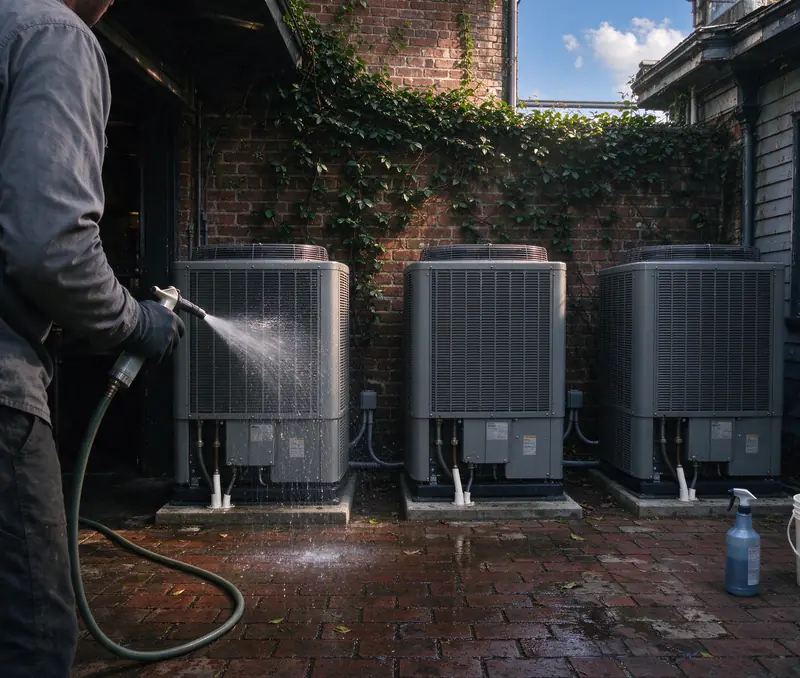
Attic units above finished ceilings
When the air handler sits over the hall, its drain decides whether a clog stays in the attic.
The primary drain
The indoor coil pulls water out of the air all summer, and it leaves through a drain line with a trap. Algae and dust build up in that line until it backs up. A cleanout fitting lets the line be flushed without cutting it.
The secondary pan
A shallow pan under the whole air handler catches what the primary drain can’t. On a replacement we size the pan to the new cabinet and set it level on the platform.
The float switch
A float switch in the pan or the drain line shuts the system off when water rises. A warm house for an afternoon is the warning; a stained ceiling is what it prevents. At startup we test it with water. The components guide shows each part.
Keep it in the attic, or move it?
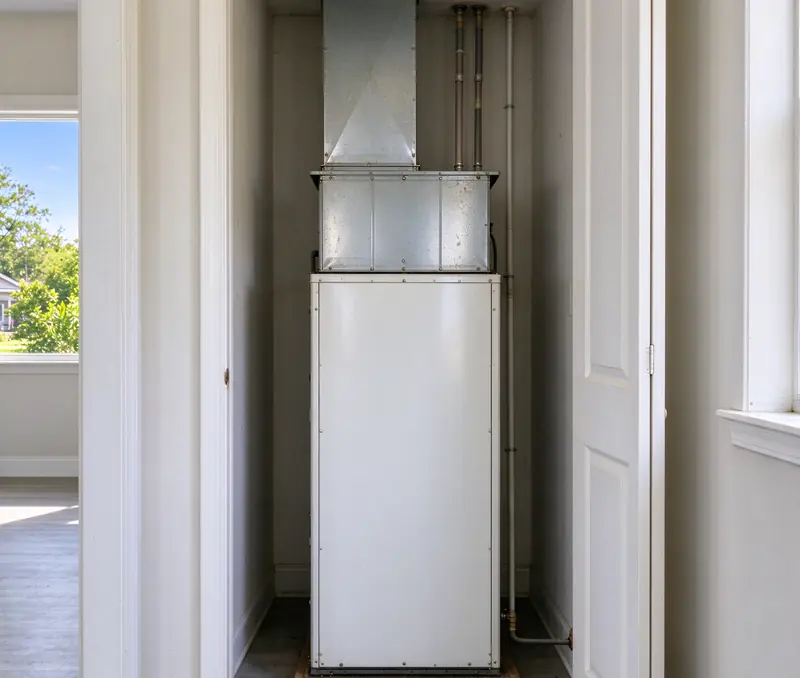
Moving the air handler into a closet takes it off the ceiling but costs a closet and more duct work. Keeping it in the attic with a proper pan, float switch and cleanable drain protects the ceiling for less. We price whichever your house can take, and the ducts are tested for leakage and static pressure either way.
Between Kenner, Harahan and the river
River Ridge runs along Jefferson Highway, with the Mississippi on one side and two cities on the others.
A parish office with city neighbours
River Ridge is unincorporated, so a heat pump replacement there is filed with the Jefferson Parish Building Regulatory Division before the work and inspected after. Kenner to the northwest runs its own permit office, and Harahan to the east is a separate city, so addresses near either line are checked first. Metairie to the north uses the same parish office. The permit guide compares them.
Little Farms to suburbs
The area along the river between Harahan and Kenner was farmland known as Little Farms until suburban building began in the early 1950s, and the name River Ridge came in 1974. Where a house dates from that build-out, its ducts, panel and drain may have been changed more than once. We test what is there rather than assume, and check the panel’s rating and spaces before choosing equipment.
What River Ridge work costs
Repairs and replacements have separate ranges, and we show both when both make sense.
Sweet Olive's typical range for a residential heat pump repair is $161 to $661. The diagnostic visit and major components such as a compressor or coil are separate lines, priced from what the diagnosis finds.
Sweet Olive's typical range for a residential ducted heat pump replacement is $4,250 to $11,750. For a replacement, we set your price after the site visit and write it into your estimate line by line, with the drain work and the Jefferson Parish permit steps shown separately.
The cost guide breaks a price into its parts, and regular maintenance keeps the drain line clear between visits.