Last updated:
The repair quote came back with the word compressor in it, or the system has been patched twice in two summers and the back rooms were never right anyway. Before you pay for a new heat pump, it helps to know whether the old one is worth saving, and whether the new one should be the same size at all.
Sweet Olive replaces ducted heat pumps in homes across New Orleans. On the first visit we read the old equipment, test the ducts, check the panel and the drain, and run a room-by-room load calculation. Your written estimate then names the new equipment, what we reuse and what is new, and prices that exact scope.
A replacement is a different job from a first installation, because most of the house is already set up for central air. The questions are which parts of that setup still work, and which ones caused the problems you are living with. If the house is heated by gas today, furnace to heat pump conversion covers that path.
Inside a Lakeview heat pump replacement
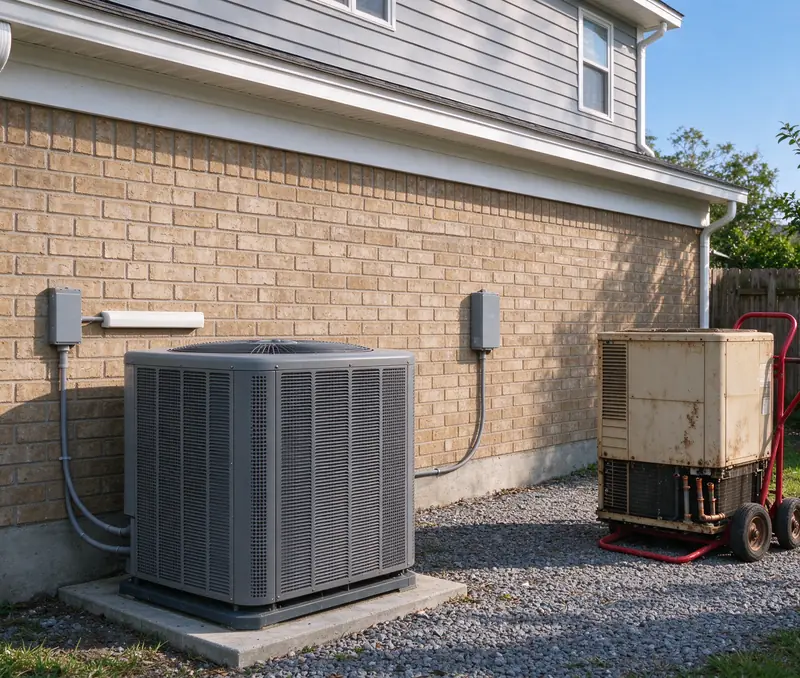
A failed compressor on an old system, an upstairs that never cooled right, and the question of whether the new one should be the same size.
- Location
- Lakeview, New Orleans
- Home
- Two-story home on a slab, about 2,100 sq ft, four bedrooms
- System
- Nominal 3.5-ton two-stage matched system, replacing a 4-ton single-stage heat pump
- Air handler
- Upstairs hall closet, same location
- Ductwork
- Existing ducts kept; a second return added upstairs
- Line set
- 35 feet, new
- Project price
- $9,650
- Duration
- 2 working days
The problem
A compressor quote on a tired system
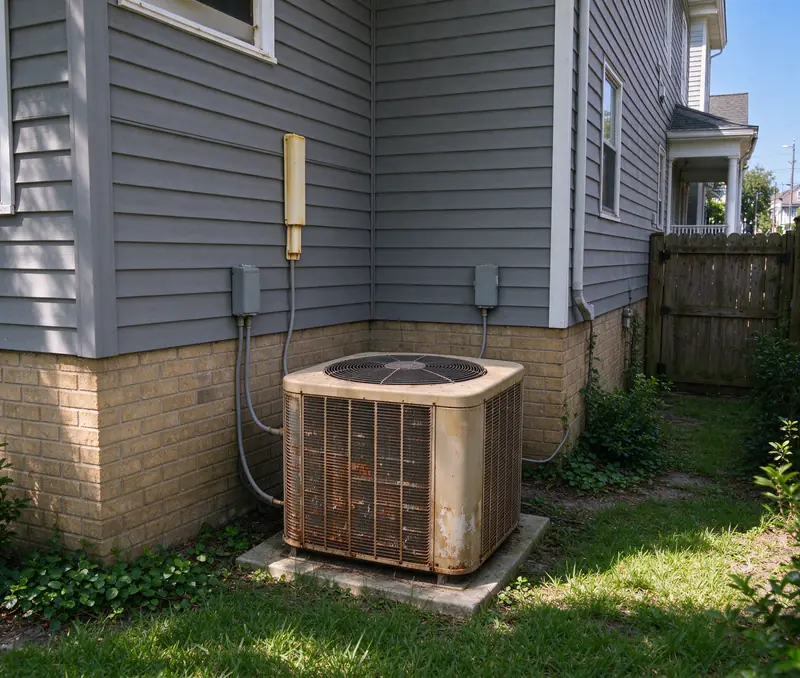
The house is a two-story home on a slab in Lakeview, about 2,100 square feet with four bedrooms. Its four-ton single-stage heat pump has a failed compressor, the outdoor coil fins are corroded, and the upstairs bedrooms have always run warm and sticky. A new compressor is a major component priced on its own, and on equipment this worn the owner asks us to price a replacement beside it.
The decision
Smaller equipment, one more return
The room-by-room load calculation supports three and a half tons, not four. The duct test finds sound supply runs but a single return grille too small for the airflow, so static pressure is high. We choose a two-stage matched system and add a second return in the upstairs hall, instead of matching the old tonnage or replacing ducts that test sound.
The work
Old system out on day one, new readings on day two
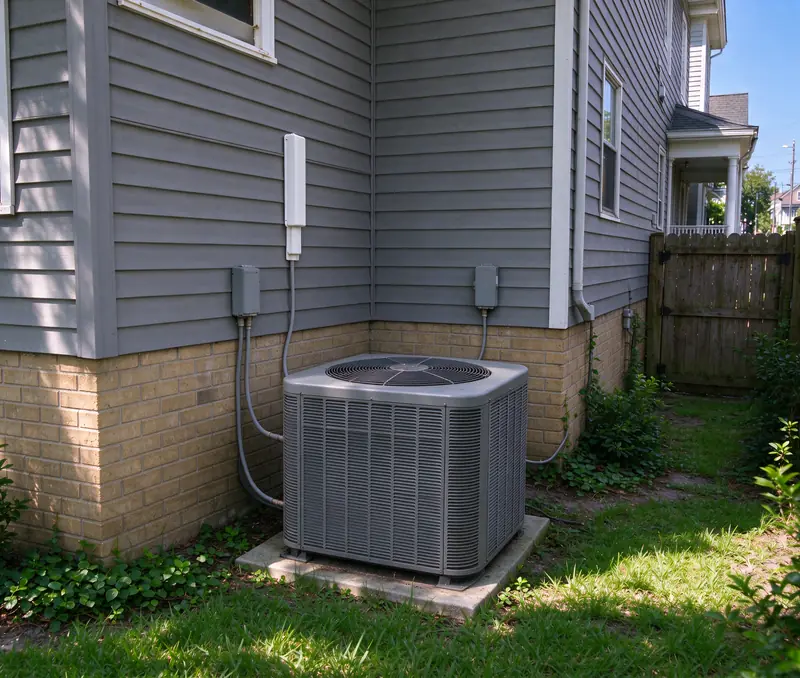
Day one protects the stairs and hall, recovers the refrigerant, removes both units and sets the new air handler in the same closet. The new return goes in through the hall ceiling while the outdoor unit is set on the existing pad. Day two runs a new 35-foot line set, brazed under nitrogen, pressure-tested and evacuated to a micron reading, then the charge, drain and float switch, and the thermostat set up for two stages and the backup heat.
The handover
Measured before you take over
We measure airflow and static pressure with both returns open, leave the readings with you and take the old equipment away. The City inspection follows the work. The aim is long low-stage runs that keep the upstairs drier, from equipment sized to the house rather than to the old nameplate.
Repair it once more, or replace it?
A failed part does not always mean a failed system. These are the things we weigh before we recommend either.
Signs that a replacement deserves a price beside the repair
- A major component has failed. A compressor, an outdoor coil or an indoor coil is priced on its own, and on worn equipment it can approach the cost of a new system.
- Repairs keep coming. A second or third refrigerant leak, or a string of electrical parts, points to a system wearing out as a whole.
- The house was never comfortable. Warm rooms, clammy air or short cycles can mean the old system was the wrong size or the airflow never worked.
- The equipment no longer fits. An addition, new windows or insulation can change the load the system was sized for.
When we recommend the repair
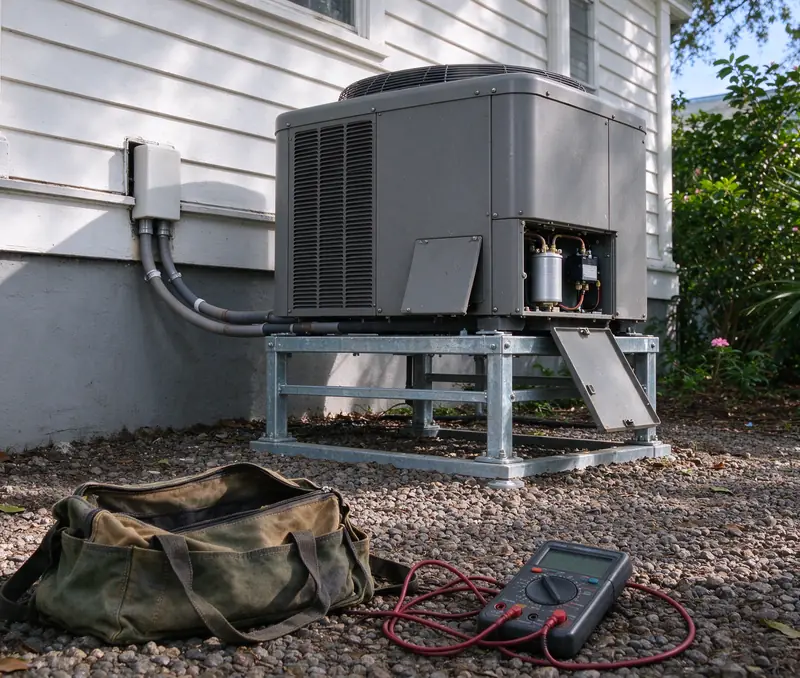
If the system is sound, sized right for the house and the fault is a part such as a capacitor, contactor, fan motor or sensor, a repair usually makes more sense. Our heat pump repair page covers that work, and the repair or replace guide shows how to compare the two prices side by side. One failure seldom proves the whole system is done, so we tell you what we found and what we can’t yet know.
What we check on the old system before pricing a new one
The old equipment tells us what the house has been asking for, and what the new system has to work with.
| Part | What we look at | What it decides |
|---|---|---|
| Nameplates | Capacity, refrigerant, electrical ratings and the manufacture date | A starting point for the load calculation, never the answer |
| Outdoor unit | Coil condition, pad or stand, clearances and where water collects | Whether the location and support can stay |
| Air handler and coil | Cabinet, coil, blower, backup heat strip and the space around them | What size cabinet fits and how it reaches the ducts |
| Line set | Size, length, route and insulation | Reuse after a pressure test, or replace |
| Drain | Primary line, trap, secondary pan and float switch | What the condensate side needs to be safe above a ceiling |
| Panel and circuits | Breaker and wire sizes against the new equipment’s ratings | Whether the existing circuits carry the new system |
| Thermostat | Wiring and the stages it can call | Whether it can run two-stage equipment and backup heat correctly |
What we look at on the existing system, and what each check decides for the replacement.
Why the old size is only a clue
The nameplate tells us what someone chose years ago, not what the house needs now. A load calculation (ACCA Manual J) adds up the heat entering each room through its windows, walls, ceiling and air leaks. In a humid summer an oversized system cools fast, shuts off early and leaves the air damp, so matching the old tonnage can repeat the old problem. Our sizing guide goes through it.
Will the new system fit your ducts, wiring and drain?
New equipment is only as good as the air path, the circuits and the drain it is connected to.
The ducts
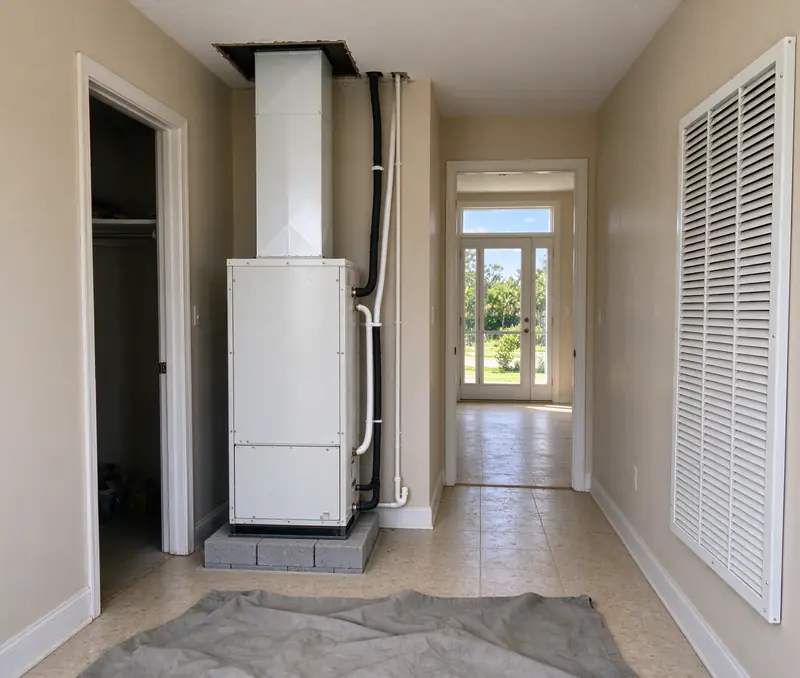
We test the existing ducts for leakage and measure static pressure before we plan to reuse them. A small return or a crushed run starves the new blower just as it starved the old one. Often the fix is a handful of sealed joints or one added return, not a new duct system; our ductwork repair page covers that work.
The drain
The air handler pulls water out of the air all summer. Where it sits above a finished ceiling, the replacement includes a secondary pan with a float switch, so a blocked drain shuts the system off before water reaches the plaster. Our humidity guide explains why so much water comes off the coil here.
The wiring
The heat pump and the air handler each run on a dedicated circuit sized to the nameplate, and the backup heat strip often draws more than the heat pump. We compare the existing breakers and wire against the new equipment’s ratings. Where they match, the estimate keeps them; where they don’t, an electrician adds the circuit as its own line. The electrical readiness guide explains the numbers.
The controls
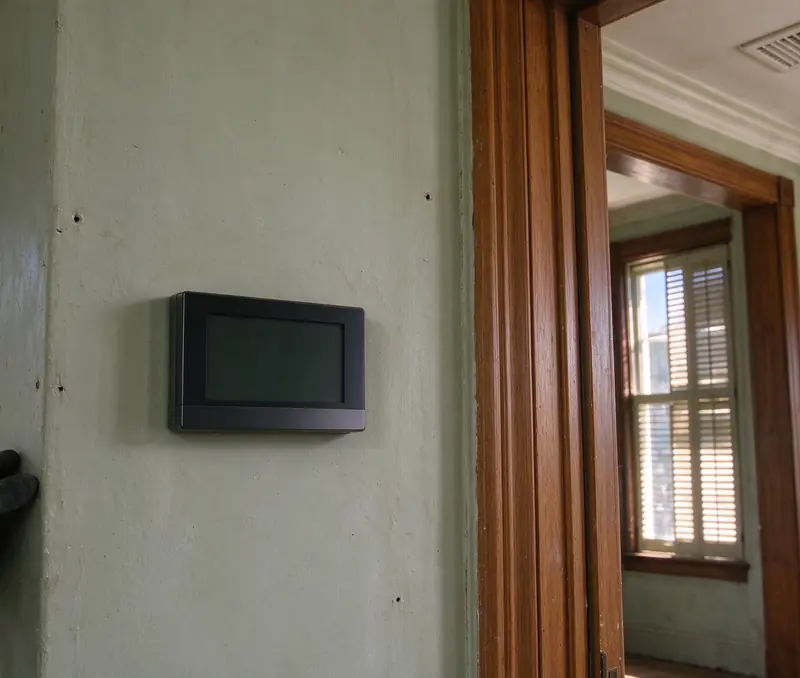
A two-stage or variable-speed system needs a thermostat that can call each stage and hold the heat strip back until it is needed. A miswired or mismatched thermostat can run the strip far too often and erase the savings of efficient equipment.
Same size, or the right size?
Once the load is known, three choices shape the new system: capacity, how it runs, and what it is paired with.
Matching the old system
Same tonnage, same type, same parts reused where they fit.
- Simple to quote
- Repeats any sizing or airflow problem the old system had
- Ignores changes to the house since it was installed
Sizing from the house
Capacity from the load calculation, stages chosen for moisture control.
- Can mean a smaller or larger system than before
- Pairs the equipment with the ducts it will actually use
- Takes a longer first visit
We size from the house and tell you when the answer happens to match the old label.
Single-stage, two-stage or variable-speed
Single-stage equipment runs flat out or not at all. Two-stage and variable-speed equipment spends most of the summer at low output, which means longer runs and more moisture removed, at a higher price. Our comparison guide covers the trade-off, and the components guide explains the compressor, reversing valve, coils and metering device a replacement changes.
Replacement day, from recovery to readings
A replacement runs in a fixed order, because each step depends on the one before it.
Recovery and removal
We protect the floors on the route in and recover the refrigerant from the old system into a recovery cylinder before anything is disconnected. Then the old outdoor unit, air handler and coil come out, along with any line set the estimate replaces.
Setting the new equipment
The air handler goes into its closet or onto its attic platform, with the plenum transitions rebuilt to fit the new cabinet and sealed with mastic. Outside, the unit goes on its pad or a raised stand with the clearances the manufacturer sets. In a local historic district, moving the unit to a new spot may need district review first.
Lines, testing and startup
The line set is brazed while nitrogen flows through it, held under nitrogen pressure to prove it tight, then evacuated while a micron gauge confirms the moisture is out. At startup we verify the charge, measure airflow and static pressure, test the drain and float switch, confirm the heat strip and defrost, and leave the readings with you. The installation process guide has the full sequence, and the permit guide covers the inspection that follows.
What a replacement costs
The new equipment is only part of the price. How much of the old setup can stay moves it just as much.
Sweet Olive's typical range for a residential ducted heat pump replacement is $4,250 to $11,750. We set your price after the site visit and write it into your estimate line by line, with each reused and each new part shown separately.
What moves a replacement price
- Capacity and efficiency tier. Two-stage and variable-speed equipment costs more than single-stage.
- What the ducts need. Sound ducts keep the price down; an added return or new runs raise it.
- Line set. Reused after testing, or new.
- Electrical work. Existing circuits that fit, or a new one; a panel upgrade is a separate line.
- Access. An attic air handler, a narrow gate or a second-floor closet adds labor.
- Permit and controls. The permit for your address and a thermostat that matches the equipment.
Rebates and tax credits
If you have an Entergy New Orleans residential account, the Energy Smart program offers rebates on qualifying equipment installed by a participating contractor, within its current funding period. The contractors who do our work take part in the program. We check your account and the proposed equipment against its current rules before counting any rebate. The federal 25C credit no longer applies to equipment placed in service after December 31, 2025, according to IRS guidance. More in our rebate guide and cost guide.