Last updated:
The short answer
A ducted heat pump has an outdoor unit with the compressor, outdoor coil, fan and reversing valve; an indoor air handler with the indoor coil, expansion device, blower, heat strip and drain; a copper line set between them; the ducts; the thermostat; and the electrical disconnect. The reversing valve lets the same parts cool in summer and heat in winter.
Key takeaways
- The system works as a set; a symptom indoors can start outdoors, and the reverse.
- The reversing valve is what makes a heat pump different from an air conditioner.
- The drain, pan and float switch protect your ceiling, and they need the most routine attention.
- The indoor and outdoor units are rated as a matched pair.
When something goes wrong with a heat pump, the part you can see isn’t always the part that failed. A dripping ceiling starts at a drain, warm air can start at a capacitor outside, and a cold house in January can start at a thermostat setting.
Sweet Olive installs and services ducted heat pumps across New Orleans, and we explain which part is involved before we price anything. This guide maps the system and what each part does. It isn’t a repair manual: anything past the filter and the thermostat settings belongs to a technician.
The system at a glance
Six parts of the system, from the attic to the yard, on a typical raised house.
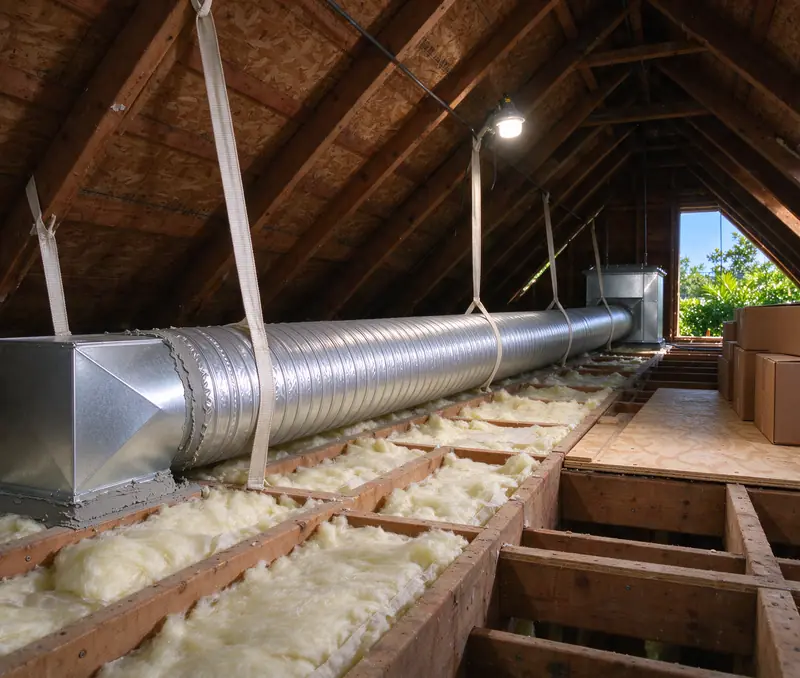
- Dark circle, Air handler: on an attic platform, over a secondary drain pan
- Ochre square, Supply runs: dropping to ceiling registers
- Blue diamond, Central return: in the hall ceiling
- Yellow triangle, Jumper duct: from a closed bedroom to the hall
- Open ring, Line set and drain: along the outside wall
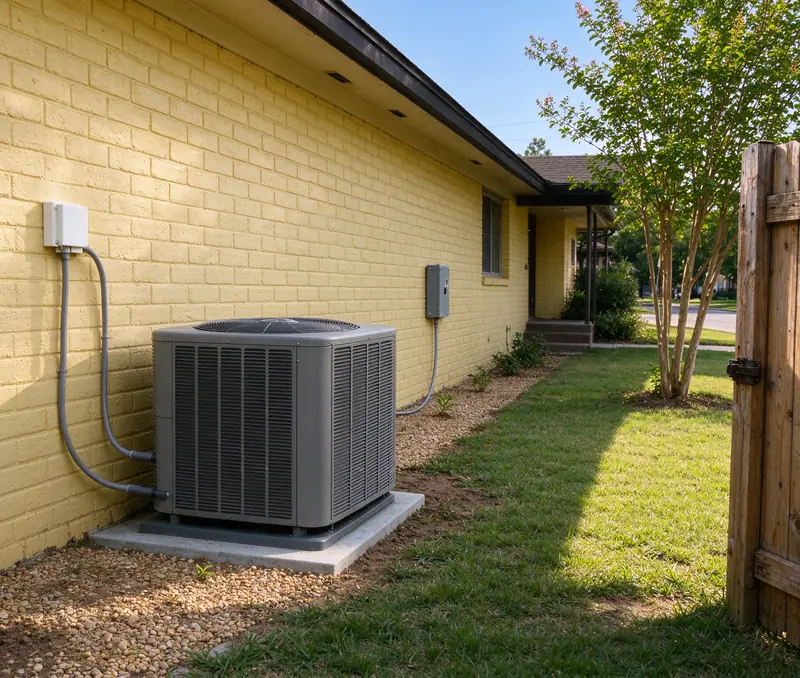
- Dark cross, Outdoor unit: on a raised stand, with its disconnect
How it fits together
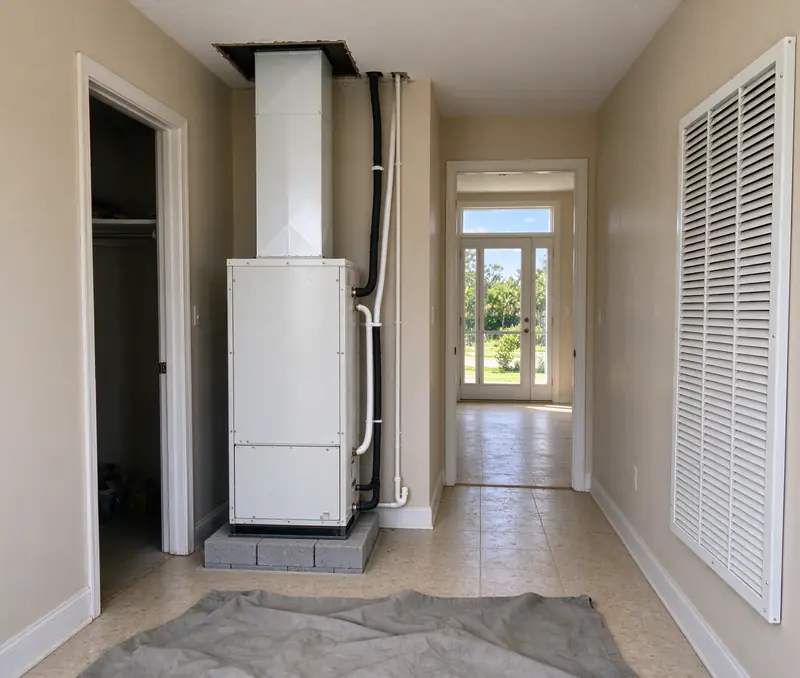
The outdoor unit and the indoor air handler are joined by a copper line set carrying refrigerant. The air handler’s blower pushes air across the indoor coil and out through the supply ducts, and the return brings it back. The thermostat tells both units what to do, and a disconnect beside the outdoor unit lets it be shut off for service.
A matched pair
The outdoor unit, indoor coil and air handler are rated together, which is why the SEER2 and HSPF2 on a certificate belong to the combination, not to one box. Replacing one half means checking the match, as our repair or replace guide explains.
What each part does
Each part, where it sits and its job in the system.
| Part | Where it sits | What it does |
|---|---|---|
| Compressor | Outdoor unit | Pumps refrigerant around the circuit and raises its pressure and temperature |
| Outdoor coil and fan | Outdoor unit | Gives heat off in cooling; collects heat from outdoor air in heating |
| Reversing valve | Outdoor unit | Switches the refrigerant’s direction between cooling and heating |
| Defrost control | Outdoor unit | Clears frost from the outdoor coil in heating mode |
| Capacitor and contactor | Outdoor unit’s electrical panel | Start the motors and switch the compressor on and off |
| Line set | Between the units | A larger insulated suction line and a smaller liquid line |
| Expansion device | At the indoor coil, and on many heat pumps at the outdoor coil too | Meters refrigerant into the coil, dropping its pressure and temperature |
| Indoor coil | Air handler | Absorbs heat and condenses water in cooling; releases heat in heating |
| Blower | Air handler | Moves air through the coil and ducts at the airflow the system is set for |
| Heat strip | Air handler | Electric backup heat for cold mornings and defrost |
| Drain pan, trap and float switch | Under the coil, and a second pan under attic units | Carries condensate away; shuts the system off if water backs up |
| Filter | At the return grille or the air handler | Keeps dust off the coil and blower |
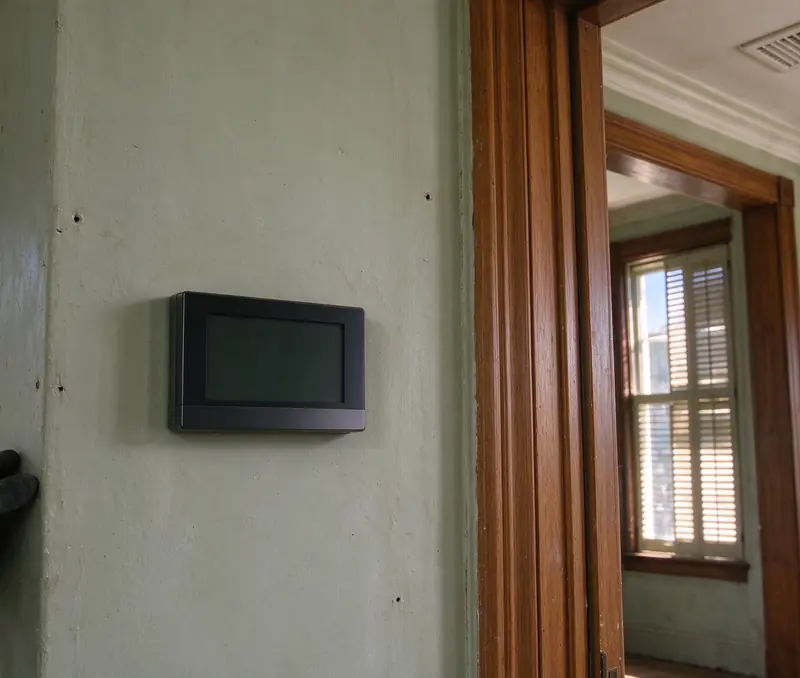
| Thermostat | An inside wall | Calls for cooling, heating, each stage, the fan and backup heat |
| Disconnect | Within sight of the outdoor unit | Lets the outdoor unit be shut off for service |
The main parts of a ducted heat pump, where each sits and what it does.
Cooling and heating with the same parts
The refrigerant does the same work in both seasons; the reversing valve changes which coil does which job.
In cooling
Heat moves from the house to the yard.
- The indoor coil runs cold and absorbs heat
- Water condenses on the indoor coil and drains away
- The outdoor coil and fan give the heat off outside
In heating
Heat moves from the yard to the house.
- The outdoor coil runs cold and collects heat from outdoor air
- The indoor coil releases that heat into the ducts
- The outdoor coil periodically defrosts while the heat strip covers the gap
One refrigerant circuit, run in two directions, is what makes a heat pump different from an air conditioner.
Why defrost matters even here
When the outdoor coil runs below freezing on a damp winter morning, frost builds on it. The defrost control briefly reverses the system to clear it, and the heat strip warms the supply air meanwhile. A steaming outdoor unit on a cold morning is usually defrost, not a fault. Our cold-weather guide explains more.
Which part a symptom points to
A symptom narrows the search. It doesn't prove the cause, which is why diagnosis comes before a price.
| What you notice | Parts it can point to | Before you call |
|---|---|---|
| Outdoor fan runs, air indoors isn’t cool | Capacitor, compressor, refrigerant charge, reversing valve | Check the thermostat mode and setpoint |
| Nothing runs at all | Thermostat, a tripped float switch, a breaker, the disconnect, a control board | Check the thermostat display and any ceiling below the air handler |
| Water in the secondary pan or on a ceiling | Blocked drain line or trap | Turn the system off at the thermostat and call |
| Ice on the line set or indoor coil | Low airflow, a dirty filter or low charge | Switch to fan only or off, and call |
| Weak airflow at some registers | Ducts, a dirty filter, a blower setting | Check and replace the filter |
| Short cycling | Oversizing, controls, a thermostat location or charge | Note how long each run lasts |
| High heating bills in winter | Heat strip running too often, thermostat setup | Check the thermostat isn’t set to emergency heat |
Common symptoms, the parts they can point to, and what to do before calling.
Where your part of the job stops
You can change the filter, check the thermostat’s mode and setpoint, and keep the outdoor unit clear of leaves and debris. Everything behind a panel, including capacitors, refrigerant, the drain trap inside the cabinet and the wiring, belongs to a technician. Our maintenance checklist and warning signs guide cover what to watch for, and heat pump repair covers the diagnosis.
The parts you don't see
Ducts, electrical circuits and controls are part of the system too, and they shape what the equipment can do.
Ducts, circuits and controls
The ducts decide how much of the coil’s capacity reaches each room; our ductwork guide covers the tests. The circuits and disconnect are in the electrical readiness guide. The thermostat decides which stage runs and when the heat strip comes on, so a mismatched control can make a sound system feel wrong. An inspection checks all of it together.