Last updated:
The short answer
A central air conditioner only cools; a heat pump cools the same way and then reverses its refrigerant flow to heat. Both use an outdoor unit, an indoor coil, a line set and ducts. Switching changes the heating side of the house, so the furnace or heat strip, the wiring and the thermostat decide the scope.
Key takeaways
- In cooling, a heat pump and a central air conditioner do the same job with the same kind of parts.
- The reversing valve, the defrost control and the backup heat are what a heat pump adds.
- What heats the house now, gas furnace, electric furnace or nothing central, sets most of the scope.
- The indoor coil and outdoor unit are chosen as a matched pair; an old coil may not suit a new heat pump.
- The best moment to switch is when the air conditioner needs replacing anyway.
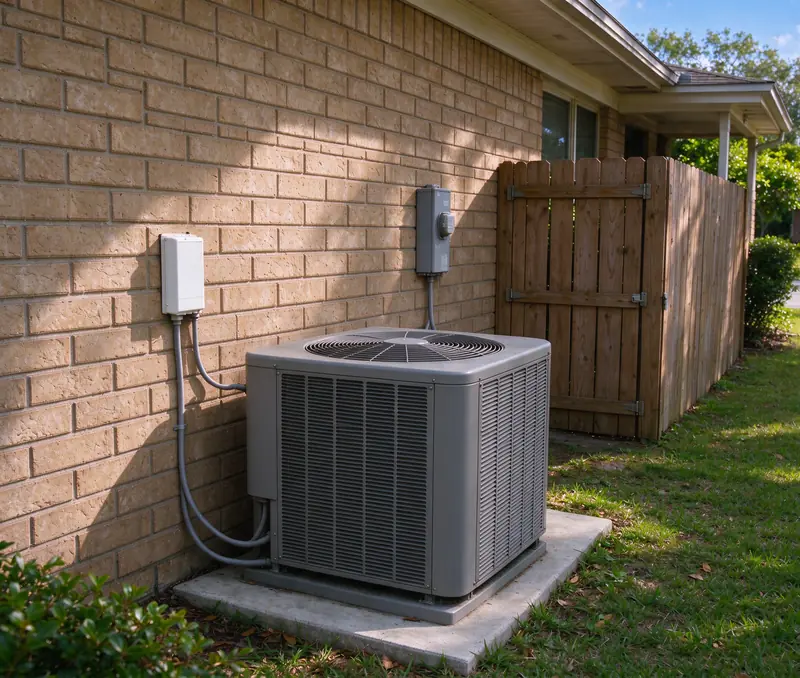
From the sidewalk, a heat pump and a central air conditioner look like the same metal box with a fan on top. In July they do the same job. The difference shows up in December, and in what has to change inside your house to get there.
Sweet Olive installs ducted air-source heat pumps across New Orleans, and many of our installations start as a central air conditioner that needs replacing. This guide shows what the two systems share, what a heat pump adds, and how the equipment you have now shapes the job.
What the two systems share
Cooling works the same way in both: the indoor coil takes heat and moisture out of the house and the outdoor unit sheds the heat outside.
| Part | Central air conditioner | Heat pump |
|---|---|---|
| Outdoor unit | Compressor and coil that release heat outdoors | Compressor and coil that release heat in summer and collect it in winter |
| Indoor coil | Cools and dries the air | Cools and dries the air in summer; warms it in winter |
| Air handler or furnace | Moves the air; a furnace or heat strip makes the heat | Moves the air; a heat strip or furnace is backup only |
| Line set and drain | Copper lines between the units; condensate drain from the coil | The same, plus defrost water at the outdoor unit in winter |
| Ducts and returns | Carry the air to each room and back | The same ducts, with the same airflow needs |
| Thermostat | Calls for cooling, and heat from a separate source | Calls for cooling, heating, the reversing valve and backup heat |
The parts of a ducted central air conditioner and a ducted heat pump, side by side.
- Dark circle, Air handler: on an attic platform, over a secondary drain pan
- Ochre square, Supply runs: dropping to ceiling registers
- Blue diamond, Central return: in the hall ceiling
- Yellow triangle, Jumper duct: from a closed bedroom to the hall
- Open ring, Line set and drain: along the outside wall
- Dark cross, Outdoor unit: on a raised stand, with its disconnect
The same ducts carry both
Because both systems push air through the same ducts, a duct problem follows you from one to the other. A leaky return or a closed bedroom with no way back makes a heat pump feel as uneven as the air conditioner it replaced. We test the ducts before choosing equipment, as our ductwork guide explains.
The same summer job
In a New Orleans summer, most of the work is pulling water out of the air. A heat pump does that exactly as an air conditioner does: through the cold indoor coil and a drain that carries the water away. Our humidity guide covers why run time and airflow matter here.
What the reversing valve adds
A heat pump has three things an air conditioner doesn't: a valve that turns the refrigerant around, a defrost control, and a plan for backup heat.
Cooling mode
Heat travels from the house to the yard.
- The indoor coil is cold and wet
- The outdoor coil is hot, and its fan blows warm air
- Water drains from the indoor coil
Heating mode
The reversing valve sends heat from the yard into the house.
- The indoor coil is warm
- The outdoor coil is cold and can frost on damp mornings
- Short defrost cycles clear the frost, and backup heat covers the gap
Same circuit, run in two directions; the controls decide which way and when.
Why a heat pump needs backup heat
As the air outside gets colder, a heat pump collects less heat, while the house loses more. On the coldest mornings a heat strip or a furnace makes up the difference, and it also warms the air while the outdoor coil defrosts. Our cold-weather guide walks through a winter morning.
What the thermostat has to know
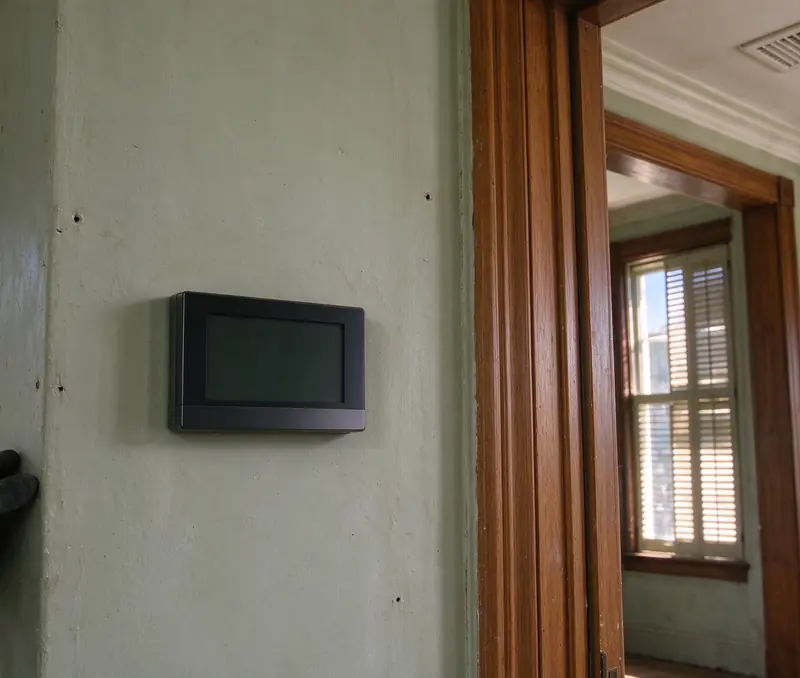
An air conditioner thermostat calls for cooling and, separately, for heat. A heat pump thermostat also switches the reversing valve and decides when backup heat may run. A control set up for an air conditioner can leave a heat pump heating on its strip alone. See our thermostat compatibility guide.
What heats your house now decides the job
The cooling side of a switch looks alike from house to house. The heating side doesn't, and it sets most of the scope.
| What you have now | What usually stays | What changes for a heat pump |
|---|---|---|
| Central AC with a gas furnace | Ducts after testing; possibly the furnace as backup | Outdoor unit and indoor coil; thermostat; the furnace stays for dual fuel or goes for an all-electric air handler |
| Central AC with an electric furnace or strip air handler | Ducts after testing; sometimes the air handler cabinet if it is listed with the new outdoor unit | Outdoor unit, and usually a matched air handler; strip size checked against the heating load |
| Central AC with no central heat (space heaters or wall heaters) | Ducts after testing | Outdoor unit, a matched air handler with a heat strip, circuits for the strip, thermostat |
| An older heat pump | Ducts after testing; often the circuits and pad | A matched outdoor unit and air handler, chosen from a new load calculation |
Common New Orleans setups before a switch, and what moving to a heat pump changes in each.
If you heat with gas
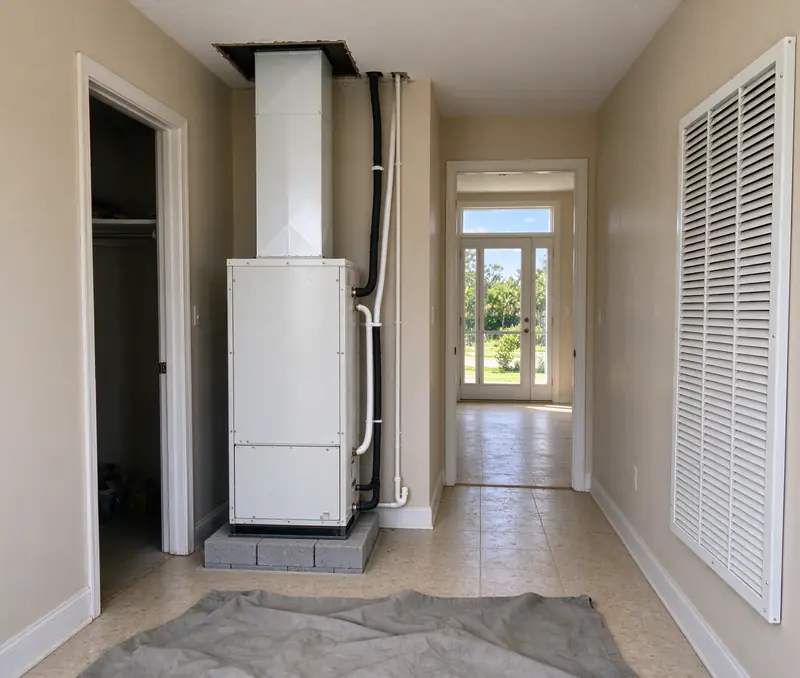
A sound furnace can stay as the heat pump’s backup in a dual-fuel setup, with the heat pump coil sitting on top of it. A worn furnace usually comes out, and a matched air handler with a heat strip takes its place. Our dual-fuel guide and heat pump and gas furnace guide compare the two.
If you have no central heat
Many houses here cool with central air and heat with space heaters on a few cold nights. A heat pump gives those houses central heat for the first time, so the air handler needs a heat strip sized to the house and the panel needs room for it. Our electrical readiness guide covers that check.
When switching makes sense
A heat pump is rarely worth tearing out a healthy air conditioner for. The timing usually comes from the equipment itself.
Good moments to compare a heat pump
- The air conditioner has failed or needs a major part. A failed compressor or a leaking coil is the point to price a replacement beside the repair, as our repair or replace guide explains.
- The furnace is worn too. Replacing the cooling and the heating at once avoids a second job and a second permit later.
- The house has no central heat. A heat pump adds it with the same outdoor unit you would buy for cooling.
- You are changing the ducts anyway. A duct rebuild is the time to settle the air handler location and its size.
Not a drop-in swap
A heat pump outdoor unit on an old cooling coil, an old thermostat and an untested duct system is a mismatched set. We price the complete combination: outdoor unit, indoor coil or air handler, backup heat, controls and ducts.
What a switch adds to the estimate
Most lines match an air conditioner replacement. A few belong to the heating side.
Lines that appear because it heats
- A matched indoor coil or air handler listed with the new outdoor unit.
- Backup heat: a heat strip sized to the heating load, or the furnace kept for dual fuel.
- Circuits for the strip, with any panel upgrade as a separate line.
- A heat pump thermostat that runs the reversing valve, the stages and the backup heat.
- Startup checks for heating: the reversing valve, defrost and the strip, alongside the cooling checks.
Sweet Olive's typical range for a residential ducted heat pump replacement is $4,250 to $11,750. A switch from central air sits in the same range, because the parts of the job are the same. We set your price after the site visit and write it into your estimate line by line, so you can see what the heating side adds.
Our cost guide shows what moves a price inside that range, and the operating cost guide compares running costs using the rates on your own bills. A higher efficiency rating lowers the electricity used for the same load, but it is not a promise of a set monthly saving.