Last updated:
You set the thermostat, the house gets there, and the rooms still feel clammy: a damp feel to the sheets, a film on the windows, a smell in the closets. Sweet Olive installs and services ducted heat pumps across New Orleans, and a damp house with a system that, on paper, is working is a common summer complaint here.
The short reason is that a thermostat only reads temperature. A heat pump in cooling mode does two jobs: it lowers the temperature, and it pulls water out of the air on its cold indoor coil. When the first job finishes before the second has had time, you get a cool, damp house. The humidity guide covers the physics in depth; this piece is about your house.
What makes a room feel damp at the right temperature
Four common causes. More than one can be at work, and a symptom alone doesn't prove which.
The system runs in short bursts
Water only starts dripping off the coil a few minutes into a cycle. A system with far more capacity than the house needs reaches the setpoint quickly, shuts off and leaves most of the moisture behind. Matching the old unit’s tonnage is no proof it was ever right; the sizing guide explains why.
The fan is set to stay on
With the fan on “On” rather than “Auto”, the blower keeps running between cycles and blows the water still sitting on the coil back into the house. It is the easiest cause to check, and the thermostat guide shows where the setting lives.
Humid air is getting into the ducts
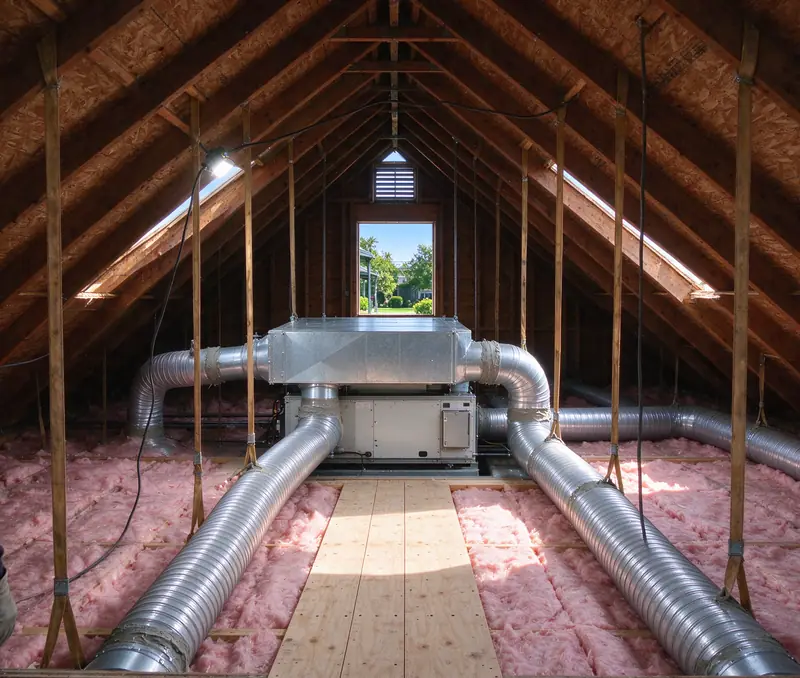
A return duct with a loose joint in a hot attic or a damp crawlspace pulls outside air straight into the system. The coil then has a bigger moisture load than the rooms alone would give it. Our ductwork guide covers how leaks are found.
Too much air across the coil
A blower set for maximum airflow moves air past the coil too fast for it to get cold enough to wring out much water. The setting is adjustable, but it has to be balanced against what the ducts can carry.
What you can check before calling
Nothing here needs a tool or an open panel. Write down what you find; it shortens the visit.
- The fan setting. Is the thermostat fan on “Auto” or “On”?
- How long a cycle runs. On a hot afternoon, time how long the system runs before it stops. Runs of only a few minutes are worth noting.
- Where it feels damp. The whole house, or one or two rooms? A single room points more toward airflow and the return path than toward the equipment.
- Closed doors. Does a bedroom feel worse with its door shut? That suggests the room has no easy way to send air back.
- The drain. During a long run, is the condensate line dripping outside? A dry drain on a humid afternoon is worth mentioning.
- A humidity reading. A small indoor humidity meter gives you a number to compare with the next day. It is a clue, not a diagnosis.
June averages 7.62 inches of rain at the New Orleans airport in the National Weather Service climate normals, so the moisture your system fights is not a rare event. If the fan was on “On”, switch it to “Auto” for a few days and see whether the rooms change before you book anything.
A typical damp-house visit, start to finish
How a visit for this complaint usually runs, from your first message to the written findings.
- Dark circle, Each room: windows, sun and ceiling height for the load calculation
- Ochre square, Attic opening: headroom and joists
- Blue diamond, Return location: where a central return can draw air
- Yellow triangle, Electrical panel: rating, open spaces and existing load
- Open ring, Outdoor spot: footing and drainage
- Dark cross, Thermostat: on an inside wall
You tell us when it is worst
The time of day, the rooms, the thermostat setting, the fan setting and how long cycles run. You don’t need to name a fault; what you noticed is what we start from.
We walk the rooms and the return path
We look at each room that bothers you, the registers, and the way air gets back to the return from every bedroom. Then the attic or crawlspace, the duct connections and the air handler.
We measure the system running
With the system running we check airflow and static pressure, the blower setting, the refrigerant charge and the drain. We compare the system’s capacity with a room-by-room load calculation for the house, and test the ducts for leakage where the signs point there.
You get the findings in writing
The estimate says what we found and what we suggest, line by line: a blower adjustment, a fan setting, sealed duct joints, a return path for a closed room, or, when capacity is far above the load, planning a replacement sized for the house.
What usually changes the result
Each cause has its own fix, which is why we measure before suggesting one.
| What we find | What changes |
|---|---|
| Fan left on “On” | Fan set to “Auto”; no parts needed |
| Blower set for too much airflow | Blower setting adjusted to suit the coil and the ducts |
| Leaking return in the attic or crawlspace | Joints sealed with mastic, or the run repaired through duct repair |
| A closed room with no way back | A return path added for that room |
| Capacity far above the load | A properly sized system, often with staging; see the staging comparison |
Causes of a damp house at the set temperature and the work that addresses each.
If you want the whole system put on record before deciding anything, an inspection measures the same things and leaves you the readings.