Last updated:
When cooling quits in a shop, an office or one tenant’s suite, the people inside feel it first, and the person who pays for the repair may be across town. You need the right unit found, the fault explained and the repair planned around the business.
Sweet Olive repairs ducted air-source heat pumps in commercial buildings across New Orleans. We start by matching the warm room to the unit that serves it, then test that unit’s parts instead of guessing from the symptom, and we price the repair before the work starts.
For a house, our residential repair page applies. If a commercial unit is near the end of its life, we price commercial replacement separately, so the urgent repair isn’t held up by a bigger decision.
What a commercial repair in Mid-City looks like
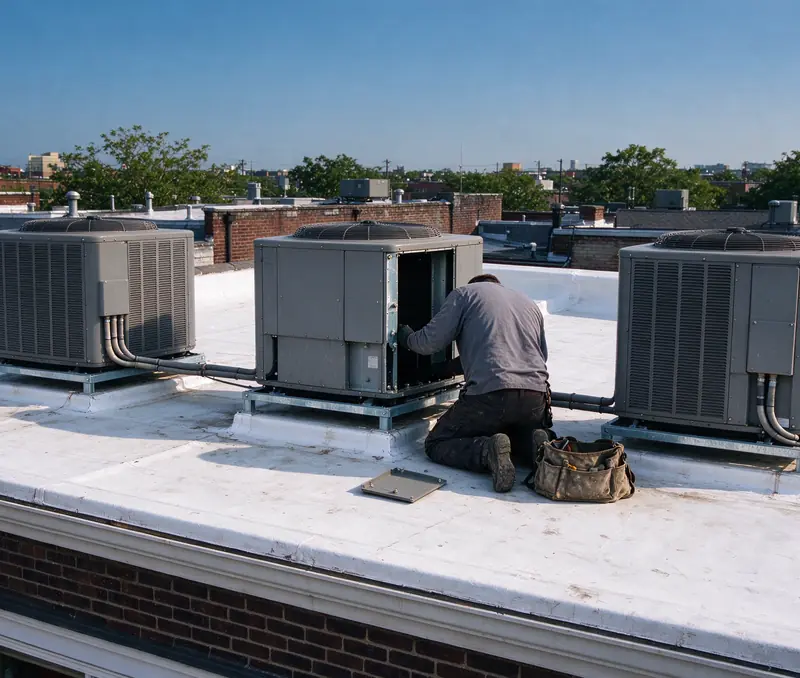
One suite warm by mid-afternoon, a stained ceiling tile and three units on one roof: finding the right unit before fixing anything.
- Location
- Mid-City, New Orleans
- Property
- Two-story mixed-use building, about 4,500 sq ft, three tenant spaces
- System
- Three split heat pumps, outdoor units on the flat roof
- Affected unit
- Nominal 3-ton system serving the upstairs office suite
- Parts replaced
- Outdoor fan motor and dual run capacitor
- Drain
- Line flushed; float switch added to the auxiliary pan
- Project price
- $1,185
- Duration
- Two visits, 5 hours on site
The call
A warm suite and a brown ring on the ceiling
The upstairs office suite in a two-story Mid-City building runs warm by mid-afternoon, and a ceiling tile over the reception desk has a brown ring. Three split heat pumps serve the building, one per tenant, with all three outdoor units on the flat roof and each air handler above its suite's ceiling. The building manager sends photos of the unit labels and the stained tile, and the tenant asks that the work stay clear of client hours.
The finding
Two faults on one system
We match the suite's thermostat to its air handler and trace the line set to the right roof unit before testing anything. On the roof, the outdoor fan stalls once its motor heats up, so pressure climbs and the unit trips on its high-pressure safety. Above the ceiling, algae plugs the condensate line and the auxiliary pan has no float switch, so overflow reaches the tile. Replacing the outdoor unit is the alternative, but the compressor readings and the line set test sound, so we price the repair.
The work
Diagnosis one afternoon, repair the next morning
The first visit, about three hours, is diagnosis: amp draws, capacitor readings, pressures and the drain. The second, two hours the next morning before the suite opens, swaps the fan motor and the 45/5 microfarad dual run capacitor, flushes and clears the drain line, and fits a float switch to the auxiliary pan, wired to shut the system off. The other two tenants keep cooling the whole time.
The record
A named unit and a drain that protects the ceiling
We run the system under load and record its readings, then write up the unit, the parts and the drain findings for the building manager, with the stained tile noted for the landlord to replace. The aim is a suite that holds temperature through the afternoon, and a drain that shuts the unit off before water reaches a ceiling again.
When to call us about a commercial unit
Some changes can wait for the next maintenance visit. These shouldn't.
- One space runs warm while the others are fine. That points to one unit, its controls or its ducts.
- Water at a ceiling tile, or a wet auxiliary pan. A blocked drain can stain tiles and ruin stock below.
- A unit that trips its breaker or keeps restarting. Electrical faults and high pressure both cause it.
- Cool air in heat mode on a cold morning. Defrost, the reversing valve or the backup heat may be at fault.
- Ice on the line set or the indoor coil. Low airflow or low charge, and running it longer makes it worse.
- New noise from the roof or a closet. A failing fan motor or bearing often gives a warning first.
What to do before we arrive
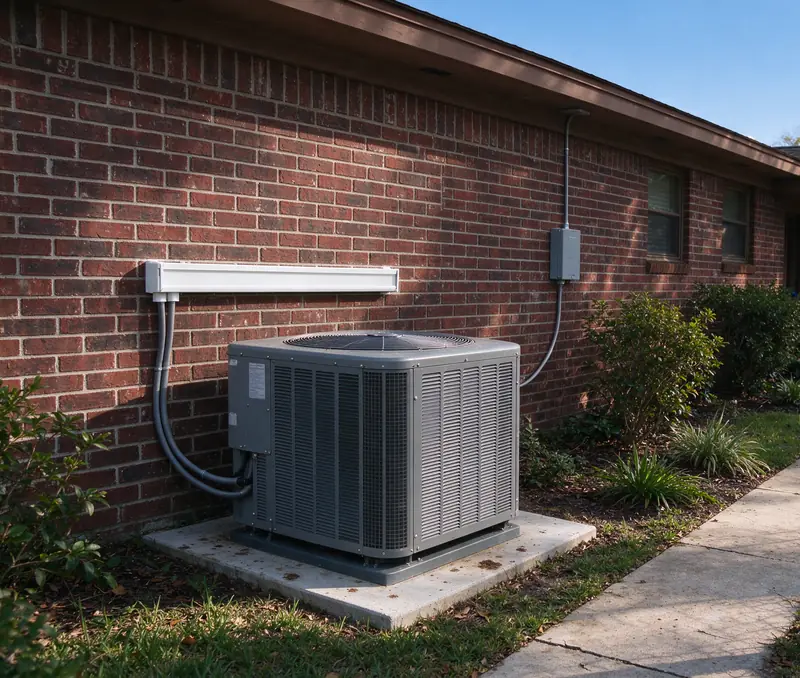
Turn off a unit that is icing or tripping, and leave the covers on. Send photos of the unit labels and the thermostat, which spaces are affected, when it started and any recent work. Our warning signs guide lists what each symptom can point to. If the last service was a long time ago, ask about planned maintenance at the same visit.
Finding the unit and the part behind the complaint
Several heat pumps can serve one building, and each one has a dozen parts that can produce the same symptom.
| Part | What we check | What a fault looks like |
|---|---|---|
| Thermostat and control wiring | Calls for cooling, heat and backup heat reaching the equipment | The unit never starts, or the heat strip runs constantly |
| Compressor | Amp draw, starting and pressures | Trips, hums, or runs without moving heat |
| Run capacitor and contactor | Readings against the rating, contact wear | A fan or compressor that won’t start, or stalls when hot |
| Outdoor fan motor | Speed, amp draw and bearings | High pressure on hot afternoons and safety trips |
| Inverter board on variable-speed units | Fault codes and output | Runs stuck at low speed, or locks out with a code |
| Reversing valve | Switching between heating and cooling | Cool air in heat mode, or the wrong mode |
| Expansion device and indoor coil | Refrigerant temperatures and airflow across the coil | Ice, weak cooling or a frosted line |
| Line set | Insulation and leak points | Sweating lines, oil stains, a slow loss of charge |
| Condensate drain and float switch | Trap, slope and the shutoff | Water at the ceiling, or a unit that stops for no clear reason |
| Heat strip and disconnect | Elements, limits, connections and fuses | No backup heat, or no power at the outdoor unit |
The parts we test on a ducted commercial heat pump, and what a fault in each one looks like.
Why one symptom isn't one cause
Warm air can come from a failed capacitor, low charge, a frozen coil, a blocked filter, a duct that has come apart above the ceiling, or a thermostat calling for the wrong mode. On a dual-fuel system the furnace side adds its own checks. We test until the readings point to one cause, and where they don’t yet, we tell you what is confirmed and what is still open. The components guide explains each part.
Planning the repair around the business
Access, tenants and hours decide when and how the repair happens.
Roofs, closets and locked rooms
Roof units need a safe way up, such as a hatch or the landlord’s ladder, and a locked mechanical room needs whoever holds the key. Tell us who lets us in and who can approve the repair, so a finding doesn’t sit while we wait for a signature.
Which spaces lose cooling, and when
Most repairs mean shutting one system down for a while. We tell you which spaces lose cooling during testing and the repair, and set the work for a time the occupants can manage. In a building with several systems, the other units keep running.
Parts and second visits
Capacitors, contactors and many fan motors fit a wide range of units. A compressor, a coil or a control board for one model may need ordering. When a repair needs a second visit, you know why and what happens in between. Where the building is changing how it heats, a commercial retrofit may be the better conversation.
Repair this unit or price a replacement?
A repair price means more when you see it next to the unit's condition.
Repair this unit
Fix the confirmed fault and keep the system running.
- The rest of the system tests sound
- The part is available for the model
- The unit has kept up with the space
Price a replacement
Plan new equipment with its own downtime plan.
- A compressor or coil failure on an aging unit
- Repeat repairs on the same system
- The space has changed since the unit was sized
We price the urgent repair on its own and, when replacement deserves a look, price it separately so you can compare the two side by side.
City permits for repairs
The City of New Orleans requires a mechanical permit for repairing or replacing mechanical equipment, not only for installing it, and the parishes around us run their own offices. Your written estimate states whether your repair needs one and who obtains it. Our repair-or-replace guide weighs the decision further.
How we price a commercial repair
The price follows the finding, so it comes after the diagnosis.
We price commercial heat pump work per project, from the equipment, the building and the access the work needs. We set the repair price after the diagnostic visit and write it into your estimate, with the diagnosis and any major component such as a compressor or coil on their own lines.
What moves a repair price
- The part and its availability. A capacitor and a compressor are very different jobs.
- Access. A roof hatch, a lift, or an air handler above a finished ceiling adds time.
- Finding the cause. Tracing units in a building with several systems takes longer than a single unit.
- Refrigerant work. A leak search, recovery and recharge are their own steps.
- Drain and safety work. A float switch, a new pan or a rerouted drain line.
- Hours. Work the building limits to certain hours can stretch over more visits.
A record that helps the next call
The work record names the unit, the readings, the parts and anything we still recommend. Keep it with the unit labels. A regular commercial maintenance plan catches the next weak part before it fails on a busy afternoon, and our maintenance checklist shows what those visits cover. Our thermostat guide helps when a control upgrade is part of the fix.